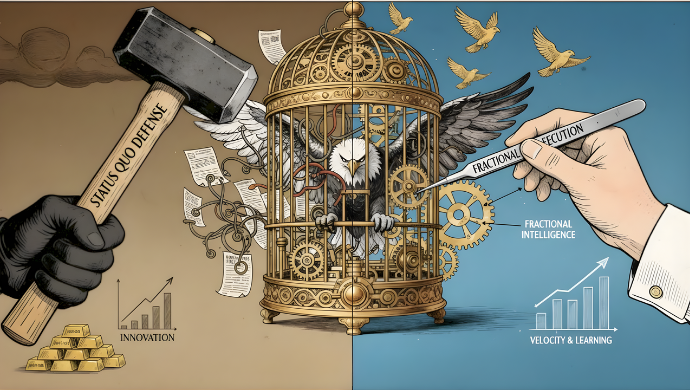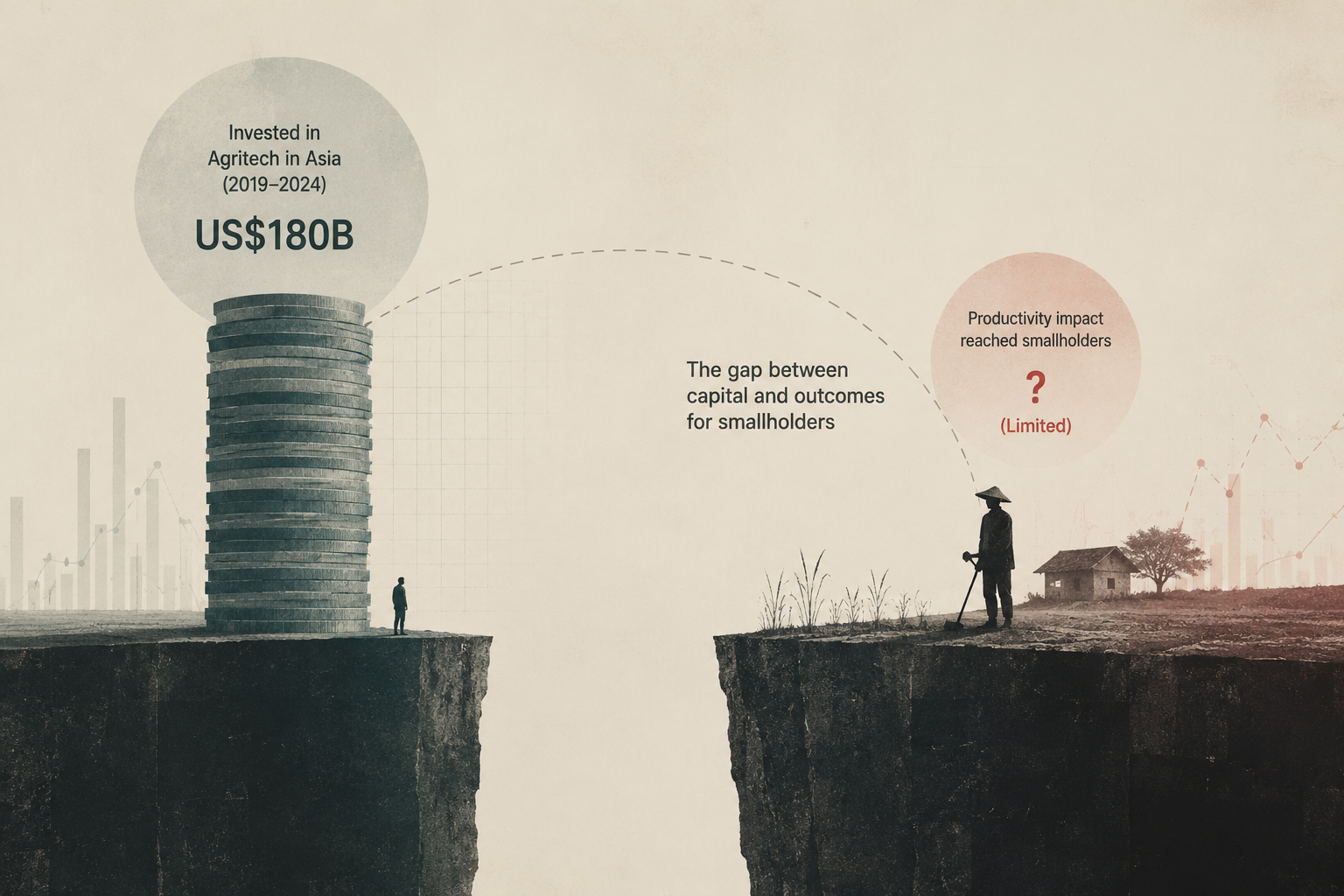

Every new administration unveils a bolder investment reform. Every new administration copies the country next door. The capital they court learned to read the difference years ago — and the citizens are learning it now.
There is a ritual that recurs across emerging Asia with the regularity of the monsoon. A government changes. Within ninety days a new logo appears, and the Board of Investment becomes the Board of Investment 2.0. Four years later a different party arrives, and 2.0 is quietly retired for 3.0 — same building, same civil servants, same brochure, fresh accent color. The press release promises a paradigm shift. The investor who actually read 2.0 recognizes every sentence.
This is not reform. It is rebranding mistaken for reform, and it is the most expensive theater in modern statecraft.
The mechanics are almost touching in their caution. A task force convenes. It studies the most successful neighbor. It produces a strategy that is, clause for clause, the safest available imitation of whatever worked somewhere else five years ago. Singapore built a sovereign onboarding agency, so we shall have one. The Gulf opened free zones, so we shall announce three. Estonia digitized, so we shall launch a portal. The document is immaculate. It is also inert — engineered to be defensible, not different. Its real author is not ambition. It is the fear of being blamed.
The say–do gap, in numbers. The brochure says fourteen days. The counter says otherwise.
Vietnam is the cleanest illustration, precisely because it is a genuine success. Registered FDI is on track to clear $40 billion, the factories are real, the growth is real. And yet, in JETRO's 2025 survey of Japanese firms operating there, 67.5% named time-consuming administrative procedures as a leading risk, and 58.7% cited opaque, inconsistent local policy. The capital arrives in spite of the machinery, not because of it.
The cost is not hypothetical. In 2024 the World Bank, the UN and Western donors warned Hanoi in writing that Vietnam had forfeited at least $2.5 billion in development funding to administrative paralysis, with another $1 billion stranded in the approval queue — nearly one percent of GDP, surrendered not to a rival but to its own paperwork. The strategy deck announced acceleration. The clerk announced a delay. Both were official. The money chose to expire rather than wait.
The gap, as investors actually price it. . Japanese firms in Vietnam citing administrative drag as a top risk67.5%Citing unclear, inconsistent local policy58.7%Development funding Vietnam forfeited to paralysis (2021–24)~$2.5B Japan's govt ICT budget consumed by legacy-system upkeep 80%
Set that beside the regional benchmark. Singapore's appeal was never lower taxes or a cleverer slogan; it was an agency, lodged at the top of government, that treated friction as the enemy and a foreign firm's first ninety days as a product to be engineered. The contrast is the whole lesson. Two Asian states, the same decade, opposite results — separated not by wealth or size but by whether the speech and the counter answered to the same sovereign.
A reform you announce but cannot execute is not a neutral act. It is a published confession that the center cannot command its own machinery.
Why version 3.0 keeps happeningEven rich, disciplined states cannot make the counter move
To its credit, the failure is not stupidity, and it is fair to say so plainly. Three forces produce the V3.0 reflex everywhere: the electoral clock, which rewards a launch over a decade-long grind; bureaucratic risk-aversion, where the clerk who blocks is never blamed and the clerk who waves through is; and the path-dependence of legacy systems that quietly outlast every reformer sent to kill them.
If you doubt how immovable the counter is, look not at a struggling state but at the most disciplined bureaucracy on earth. In 2020, as administrative-reform minister, Japan's Taro Kono declared war on the hanko seal and the fax machine. He won headlines. Years later, after a cabinet-level Digital Agency and a celebrated 2024 "victory" over the floppy disk — yes, the floppy disk, still mandated by more than a thousand regulations into this decade — the fax and the seal endure, and roughly 80% of government IT spending still goes to maintaining legacy systems. Japan is not careless or poor. It is proof that announcing a reform and executing one are different acts of state, performed by different people, on different timelines, and that the second is far harder than the first.
Which is the uncomfortable corollary: if Tokyo, with its competence and its surplus, cannot make the counter obey the minister, the emerging-market government issuing its third rebrand in twelve years is not facing a marketing problem. It is facing the hardest problem in governance, and treating it as the easiest.

The monopoly nobody is allowed to name. A local monopoly meeting a global market
Here is the part ministries dislike, so let us state it without cushioning. A national bureaucracy is, functionally, a monopoly — the sole legal vendor of identity, incorporation, permits, the right to reside and to build. It funds itself by compulsion rather than persuasion. For all of modern history it faced no competitor, and so it never once had to answer the question every business answers before breakfast: why would anyone choose us?
Monopolies do not innovate; the incentive runs the other way — toward protecting the queue, not shortening it; toward the form that justifies the clerk, not the citizen who waits. This is physics, not malice: the predictable behavior of an institution that cannot be left.
But two curves have crossed. Capital mobility has never been higher, and digital identity now lets a person be economically resident in a country they have never visited. Put those together and a national bureaucracy stops being a monopoly and becomes what it always secretly was — a local provider in a suddenly global market for jurisdiction. This is the engine beneath what analysts now call digital arbitrage: when switching costs collapse, the captive customer becomes a chooser.
And what happens to a monopoly the instant leaving becomes possible?
The smallest places noticed first, because they had to. Estonia, population 1.3 million, has enrolled more than 126,000 e-residents — digital citizens of nowhere who incorporate in Tallinn without setting foot there — and its 2020 digital-nomad visa has since been copied by over a third of the world's countries. Rwanda rebuilt from the 1994 genocide to register a company in under twenty-four hours, vaulting 76 places up the World Bank's rankings to become the first African nation ever named the world's top reformer. Neither had scale or wealth. Both had the one thing that is entirely free and almost never spent: the will to make the counter move in the direction of the speech.
At the frontier the model turns stranger still — Honduras's charter-city experiments selling "governance as a service," a jurisdiction you opt into, marketed openly as an alternative to a failing state. The politics are fierce and the experiment may not survive its host. But the premise is the warning shot: governance is becoming a product, and products have substitutes. A monopoly that has never competed has no muscle for it. When the disruptor finally arrives, the incumbent does not get one rival. It gets two hundred — every other jurisdiction, every digital residency, every zone, all at once, all one click away, each making an offer your counter never bothered to make.
What breaking the ritual would actually requireThree tests, none of which can be passed by a press release
The diagnosis is not an excuse to stop at diagnosis. Breaking the V3.0 loop does not need a fourth rebrand; it needs three things a logo cannot deliver:
1Map the say–do gap at counter level. Publish the median permit and visa time against the advertised one. If the brochure says fourteen days and the queue says forty-one, that number is your real investment policy.2Tie ministerial KPIs to processing time, not press releases. The minister is rewarded today for the announcement. Reward the deletion of a step instead, and the steps will start to vanish.3Publish a live compliance dashboard. Sunlight on the counter does what no strategy deck has ever done — it moves the clerk, because now the gap has an author.
Note what every item shares: each attacks the invisible thing — the incentive at the counter — and none of them is a new institution to be launched and photographed. That is exactly why they are rarely done. They are unglamorous, and they assign blame to the center rather than diffusing it into a brochure.
So the rebrand reflex is not merely vain. It is a clock running down. Each empty cycle spends the credibility the state will need on the day the citizen, the founder, and the foreign investor finally have somewhere else to go — and discover that the only thing the old monopoly ever truly sold them was the absence of an alternative.
The state has always had customers. It has simply never been forced to admit it. Reform, the small nations have proven, is astonishingly cheap — a matter of will, not wealth. The only open question is whether the people who run the machinery will build a value proposition before someone else builds one for them, and walks off with the customers.
The closing question — for the CEO, and the minister reading over their shoulder. If your nation's investment agency were a startup, and citizens and capital could switch providers tomorrow morning — would anyone renew? And the last time you announced a reform: did you confirm the clerk at the counter had been told — or did you assume the speech was the execution?